Bespoke furniture in a rented apartment: what is actually possible
Key Takeaways
- In a rental, bespoke work is possible as long as it is reversible: you install it, you remove it, you leave the place as you found it.
- Three families matter: freestanding movable pieces, reversible systems that drill only lightly, and fixed installations that need written landlord consent.
- A written agreement with the landlord protects everyone and settles who keeps the work when you leave.
- Robust materials and demountable joinery let a piece travel with you from one home to the next.
There is a common assumption that renting means catalogue furniture: you do not commission bespoke work in a home whose walls you do not own. It is an understandable reflex, yet largely outdated. In Switzerland, where tenancies often run for years and many people rent long-term, living in a badly organised apartment just because it is not yours is a real loss. Bespoke work in a rental is not only possible — it is commoner than people think, provided you tell apart what is movable, what is reversible and what needs the landlord's consent. This article offers a clear way to think about it: which solutions go in without drilling or damage, which deserve written authorisation, and how to negotiate cleanly so your home looks like you without causing friction when you hand back the keys. The figures mentioned are indicative ranges to confirm with a craftsman; the golden rule, meanwhile, never changes — in a rented home, anything you put in must also be able to come out.
Three families of bespoke work, three starting rules
Everything comes down to a simple question: is it fixed, reversible or movable? A bespoke piece is not necessarily something sealed to the wall. It helps to sort options into three families, each with its own constraints and rules.
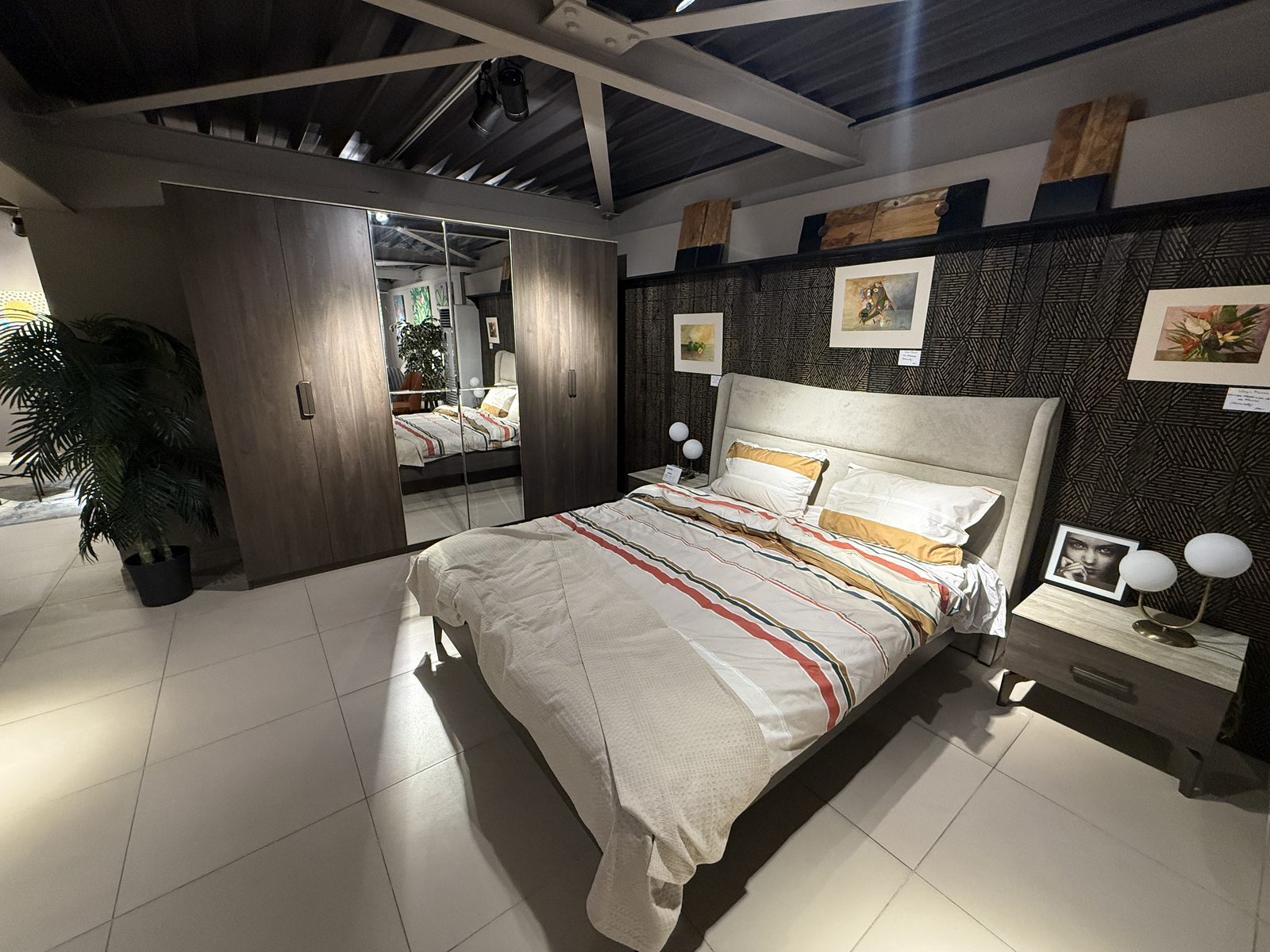
- Freestanding, movable pieces: a wardrobe, bookcase or sideboard built to your measurements, standing on the floor, assembled and taken apart without touching the walls. No consent, no trace when you leave.
- Reversible systems: elements that use the walls more lightly — tension rails, adjustable feet, removable plinths or profiles — and come away leaving minimal, sometimes zero, marks.
- Fixed installations: a fitted wardrobe or built-in banquette, a sliding door mounted on a track across an opening. This crosses into near-structural fit-out and needs the landlord's written agreement.
What goes in without fuss or consent
The first family is the freest one, and in a rental it is often the most useful. A floor-standing bookcase that fits a wall exactly, kitchen cabinetry at your heights that fills a wasted gap, a made-to-measure headboard in the bedroom: none of that fixes the apartment. Built with real joinery and serious materials, such a piece goes in in a day and comes apart when you leave, like a good piece of vintage furniture. The gain over the catalogue is obvious: the dimensions adjust to the centimetre — to the beams, the corners, the skirting boards — precisely what standard furniture cannot do. You reclaim odd recesses nobody uses, and you get rid of the gap behind the bookcase that quietly becomes a dumping ground.
Reversible systems: the happy middle
Between a freestanding piece and a fixed installation lies a whole range of reversible systems worth knowing. A bookcase stabilised by tension rails, an upper cabinet held by a removable plinth, elements resting on adjustable feet that take up uneven floors: so many ways to secure furniture without sealing it in. The principle is simple: you use the space and sometimes a light anchor point on the wall, but every fixing stays removable and is filled in seconds. This is an ideal answer for a wardrobe in a rented bedroom, storage columns in a hallway, or a desk that fills a lost corner. It demands care at the design stage — the piece must be drawn to stand firm and safe with no visible hardware — but the reward is a home fully adapted to you, followed by a departure without drama.
A good rental piece is judged at two moments: the day it goes in and the day it comes out. If it comes apart without a trace and without a struggle, it was well designed.
When to ask your landlord first
As soon as a project touches the walls, partitions, ceilings or services — a sliding door on a track, a fitted wardrobe, a room divider, any electrical work — prudence calls for a conversation with the agency or the owner. The ideal approach is simple yet mistakenly feared as complicated: present the project clearly, offer a short written document describing the work, its value, how reversible it is, and what happens to it at the end of the tenancy. You might agree, for example, that the installation stays and offsets part of the reinstatement, or on the contrary that it will be removed and the place returned to its original state. Writing it down protects both sides and prevents money disputes when the three months' notice come around. It is a healthy negotiation, far easier to conduct before drilling than to repair afterwards.
Materials that travel
In a rental, the choice of materials counts double: they must stand up to daily use, but also survive a possible move and repeated assembly. Compact laminate or melamine with solid edges handles transport and cleans in one gesture; oiled woods age well and repair with a light sanding; well-finished Egger panels offer an excellent strength-to-cost ratio for furniture you take apart and rebuild. Avoid fragile surfaces and permanently glued assemblies, and favour screw joinery, demountable facings and adjustable feet. This “travel-ready” approach makes the furniture almost eternal: what costs once moves from home to home instead of heading to a dump at every move — a win for your budget and for the planet alike.
- Favour screw joinery and demountable structures over permanent glue.
- Choose tough finishes (melamine with solid edges, oiled wood) that survive taking apart.
- Adjustable feet and tension rails for stability without anchoring.
- A well-designed piece rebuilds in the next home: you invest once.
Living well in a rental is not a contradiction: bespoke work adapts to it as long as it is designed to be reversible and negotiated openly. The ranges and advantages mentioned here are indicative — they draw on common joinery and fit-out practice and on what the Swiss construction and housing statistics of the Federal Statistical Office track (https://www.bfs.admin.ch/bfs/en/home/statistics/construction-housing.html), the practical guides of the Hausinfo portal (https://www.hausinfo.ch/en/home.html) and Egger's documentation of panel characteristics (https://www.egger.com). Your craftsman will help you settle, together, the solution that fits your tenancy.
Renting and tired of storage that does not fit, but worried about your lease and your deposit? Message us on WhatsApp at +41 79 888 47 73: we design reversible, demountable pieces that fill your exact spaces. Swiss workshop-made, careful finishing and installation.